Several North Carolinians have already begun dedicating themselves to reversing the seagrass decline. In response to the loss of large quantities of North Carolina’s essential seagrasses, twenty-five state agencies, universities, and conservation groups have come together to create the Albemarle-Pamlico Submerged Aquatic Vegetation (SAV) Partnership in order to promote the restoration of seagrass3.
Meanwhile, a team at the UNC Institute of Marine Sciences is forging ahead with a proposed plan for remedying the decline in seagrass populations. Professor Joel Fodrie and his marine biology lab have spent the last two years creating and installing over 2,500 Artificial Seagrass Units, also known as ASUs, in North Carolina’s Pamlico-Albemarle Sound System (See Figure 4)5. They are testing two main kinds of seagrass structure – continuous and fragmented – to identify which type fosters the most growth and diversity in marine life. Fodrie’s team has placed their substitute seagrass beds right beside the real beds for periods of one week at a time and are continuously monitoring the ASU’s to see how much marine life has begun to inhabit them6. Once Professor Fodrie’s lab conclusively determines which kind of seagrass structure is the most suitable for marine species, they can implement Artificial Seagrass Units all across North Carolina’s coastal waters to hopefully save the state’s aquatic ecosystems.
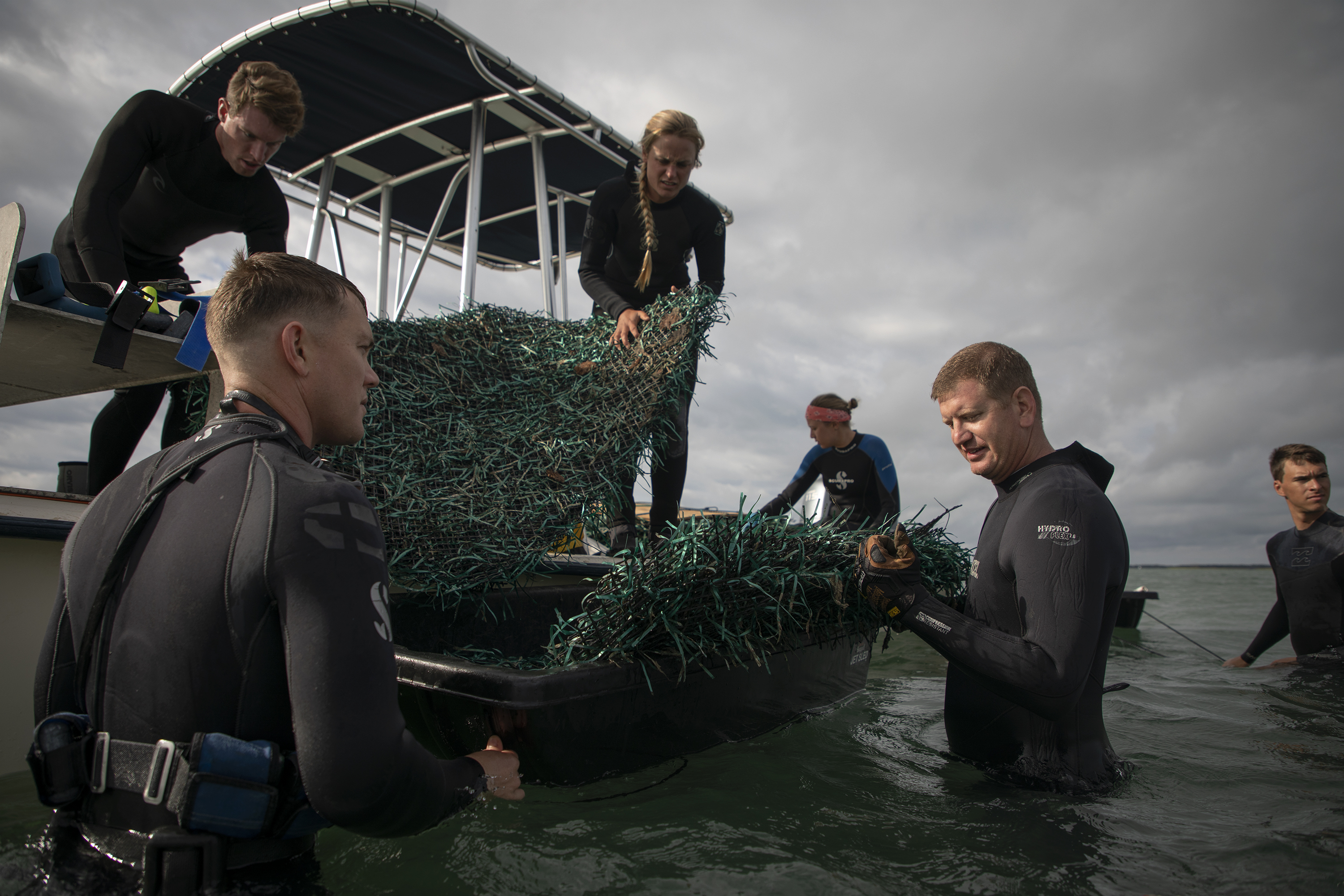
Source 4: UNC Institute of Marine Sciences (September 2019)
The issue of declining seagrass populations has captured the attention of more than just Professor Fodrie. CSA Ocean Sciences, an international marine environmental consulting firm, has been conducting research about the relationship between withering seagrass patches and powerful water currents. Unlike the researchers at UNC, the scientists at CSA Ocean Sciences believe that the answer to reversing the decline in seagrass lies in controlling wave energy2. Recently, CSA Ocean Sciences announced that a new Wave Attenuation Unit was being built to serve as an “open-water living shoreline” in the midst of a large patch of seagrass in the coastal waters (See Figure 5)2. Their Wave Attenuation Unit utilizes wave forecasting technology to break large waves and strong water currents before they can reach the seagrass beds, thus allowing the seagrass beds to coalesce safely and sustainably2. The effectiveness of the Wave Attenuation Unit in promoting seagrass growth in North Carolina’s coastal waters will be evaluated over the next five years.
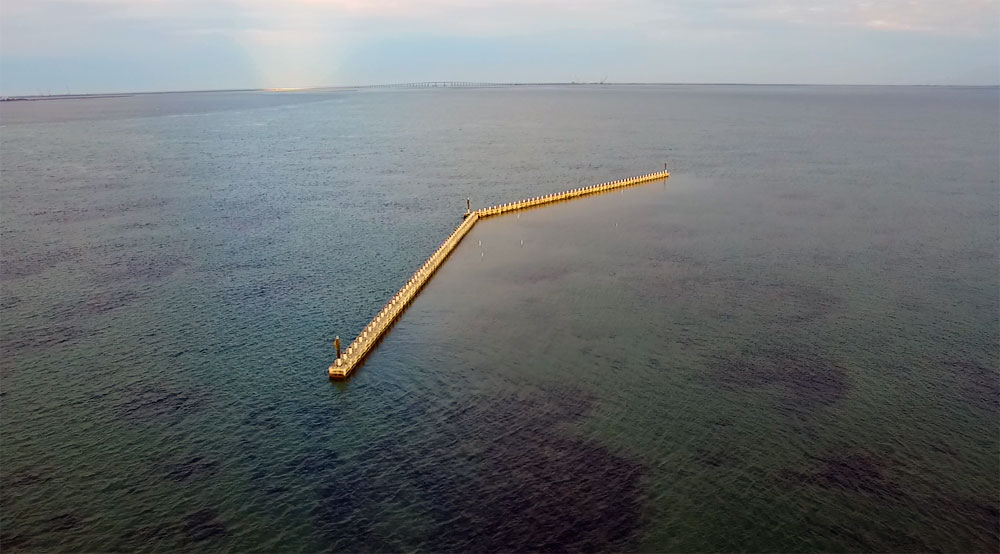
Source 1: CSA Ocean Sciences Incorporation (August 2019)
These fearless trailblazers are paving the road to recovery for North Carolinian seagrasses, but they cannot do it alone. We can all play a part in saving our seagrasses. By reducing our waste, limiting our use of fertilizers and pesticides, exercising caution when boating or fishing, and being cognizant of our environmental footprint, we can make a lasting positive impact in our oceans. If we remain dedicated and diligent in protecting our seagrasses, our marine ecosystems and coastal communities will thrive for years to come.
 Seagrass Science